A Step in the Right Direction

A Step in the Right Direction

Wednesday, January 12, 2011

Bunions

The medical term for bunions is Hallux Valgus and it is one of the most common problems seen in a podiatric office. A bunion is a prominent bump on the inside of the foot around the big toe joint. This is a bone protruding towards the inside of the foot. With continued movement of the big toe towards the smaller toes, it is common to find the big toe resting under or over the second toe. Some of the symptoms of bunions include inflammation, swelling, and soreness on the side surface of the big toe.

Another type of bunion wh
ich some people can experience is called a Tailor's bunion or a bunionette. This is on the outside of the foot towards the joint at the little toe. It is a smaller bump that forms due to the little toe moving inwards, towards the big toe.

This condition is experienced mostly by women because it can be caused by wearing improper fitting footwear. Tight, narrow dress shoes with a constrictive toe box can cause the foot to begin to take the shape of the shoe, leading to the formation of a bunion. Women have a tendency to wear dress shoes that are too small for their feet. Their toes are squeezed together in their shoes causing the first metatarsal bone to protrude on the side of the foot.

It is important for men
and women to realize that wearing dress shoes and boots, which are tapered in the toe area, can cause the bunion to worsen to the point where surgery may be necessary.

The best way to alleviate the pain with bunions is to wear properly fitting shoes. Shoes with a high, wide toe box is recommended for people with forefoot pain. Orthotics are also recommended for this condition to provide extra comfort, support and protection.

Other conservative treatments include using forefoot products such as bunion sleeve, or
bunion night splints. These conservative treatments can limit the progression of the bunion formation, and relieve pain.

This is a picture of a bunion sleeve which has a gel that fits over the sore bunion area. It helps to protect the bunion from rubbing in the shoe and provides comfort.

This can be found at our website at www.vailfoot.com. There are many other products for bunions also on this website.

If you experience any of these symptoms just give our office a call at 419-423-1888 to set up an appointment Dr. T. F. Vail, DPM

Saturday, January 8, 2011

Sesamoid injuries in the foot

A sesamoid is a bone embedded in a tendon. They are found in several joints in the body. In the foot the sesamoids are two pea-shaped bones located in the ball of the foot beneath the big toe joint.

Acting as a pulley for tendons, the sesamoids help the big toe move normally and provide leverage when the big toe "pushes off" during walking and running. They also serve as a weight-bearing surface of the first metatarsal bone , which is the long bone connected to the
big toe and absorbs the weight placed on the ball of the foot when walking or running.

Sesamoid injuries can involve the bones, tendons, and surrounding tissue in the joint. They are often associated with activities requiring increased pressure on the ball of the foot like running, basketball, football, golf, tennis and ballet. Also people with high arches are at risk for developing sesamoid problems.

There are three types of sesamoid injuries:
Turf toe is an injury of the soft tissue surrounding the big toe joint. It usually occurs when the big toe joint is extended beyond its normal range. There is immediate, sharp pain and swe
lling. It may affect the entire big toe joint and limits the motion of the toe. Sometimes a pop is felt at the moment of injury.
Fracture: A break in a sesamoid bone can be either acute or chronic. An acute fracture is caused by trauma, a direct blow or impact to the bone. Produces immediate pain and swelling at the site of the break but usually does not affect the entire big toe joint. A chronic fracture is a stress fracture which is a hairline break usually caused by repetitive stress or overuse. A stress fracture produces longstanding pain in the ball of the foot beneath the big toe joint. It is aggravated with activity and relieved with rest.
Sesmoiditis is an overuse injury involving chronic inflammation of the sesamoid bones and the tendons involved with those bones. It is caused by increased pressure to the sesamoids. It is a dull, longstanding pain beneath the big toe joint.

The podiatrist may try padding in the shoe to cushion the inflamed area or the toe may be taped or strapped to relieve the area of tension. Or the foot may be placed in a cast. Crutc
hes may be used to prevent placing weight on the foot. Oral medications like nonsteroidal anti-inflammatory drugs like ibuprofen are often helpful. There may be physical therapy ordered for strengthening and ultrasound. Steroid injections into the joint to reduce pain and inflammation may be used and custom made orthotics may be prescribed for long-term treatment

check out our online store at www.vailfoot.com for powersteps to help support your foot if you are unable to come into the office for custom made orthotics.
If you live in the area and experiencing pain in the ball of your foot give Dr. T. F. Vail's office a call at 419-423-1888 to set up an appointmnet.

Sunday, January 2, 2011

flat feet

Posterior tibial tendon dysfunction is one of several terms to describe a painful, progressive flatfoot deformity in adults.

This is a progressive, symptomatic deformity resulting from gradual stretch of the tibialis posterior tendon as well as the ligaments that support the arch of the foot.

Most flat feet are not painful, particularly those in children. In adults there can be pain because soft tissues have been torn. The deformity progresses or worsens because once the ligaments and tendon are lost, nothing can take their place to hold up the arch of the foot.

A person with flat feet has a greater load placed on the posterior tibial tendon which is the main tendon supporting the arch of the foot. With aging it leads to decreased strength of muscles, tendons and ligaments. The blood supply diminishes to tendons as arteries narrow. Heavier, obese patients have more weight on the arch and have greater narrowing of arteries due to artherosclerosis. In some people the posterior tibial tendon finally gives out or tears.
This is a slow, gradual stretching followed by inflammation and degeneration of the tendon. Once the posterior tibial tendon stretches, the ligaments of the arch stretch and tear. The bones of the arch then move out of position with body weight pressing down from above. The foot rotates inward at the ankle in a movement called pronation. The arch appears collapsed, and the heel bone is tilted to the inside.

The most accurate diagnosis is made by a podiatrist by observing the foot while the patient is walking. The affected foot appears more pronated and deformed compared to the unaffected foot. Muscle testing will show a strength deficit.

An MRI can show tendon injury and inflammation but cannot be relied on with 100% accuracy.

The inflammation and tendon injury will respond to rest, protected ambulation in a cast, as well as anti-inflammatory therapy. Follow-up with custom-molded orthotics are critical to maintain stability of the foot after initial symptoms have been calmed.

Long-term use of a foot brace is required to stop progression of the deformity without surgery.

In cases where orthotics and braces have failed surgery is the next alternative. The goal of surgery is to eliminate pain, stop progression of the deformity and improve mobility of the patient. Procedures commonly used to correct the condition include tendon debridement, tendon transfers and joint fusions.

If you think you may have flat feet, give Dr.T. F. Vail's office a call at 419-423-1888 to set up an appointment to see what can best benefit your feet.

Sunday, December 26, 2010

tarsal tunnel

The tarsal tunnel is a space in the foot formed between bones and overlying fibrous tissue. Within the tarsal tunnel lies a nerve called the posterior tibial nerve. The tarsal tunnel is walled on one side by sturdy bones, and on the other by tough fibrous tissue.

Tarsal tunnel syndrome results when the posterior tibial nerve is compressed within the tarsal tunnel. This is similar to carpal tunnel syndrome that you can experience in the wrist. Both of these conditions result when a nerve is pinched within a confined space. When space becomes tight, the tibial nerve is pinched.

Patients commonly complain of numbness over the bottom of the foot, as well as complaints of pain, burning, and tingling over the base of the foot and heel. It can be confused with plantar fascitis or heel spurs.

It can be caused by the result of a fracture, bone spurs, ganglion and other benign tumors, muscle impingement or foot deformities.

To diagnose this condition can be confusing. Tapping on the nerve as it passes through the tarsal tunnel, or the Tinel's Test may create the symptoms and indicate tarsal tunnel syndrome as the cause of the problem. An EMG test would show how well a pulse of electricity conducts through the nerve may help with the diagnosis.

Treatment begins with an anti-inflammatory medications and possibly a cortisone injection into the area around the nerve. Orthotics and change in footwear may also help to relieve the symptoms.

It none of these help then a surgical procedure may be necessary to release the tarsal tunnel. When this procedure is preformed an incision is made to open up the tarsal tunnel and decrease pressure on the posterior tibial nerve. This would be similar to a carpal tunnel release in the wrist.

So if you are experiencing any of the above symptoms give the office of Dr. T.F. Vail a call to see if this could be your situation. 419-423-1888


Saturday, December 11, 2010

Morton's Neuroma

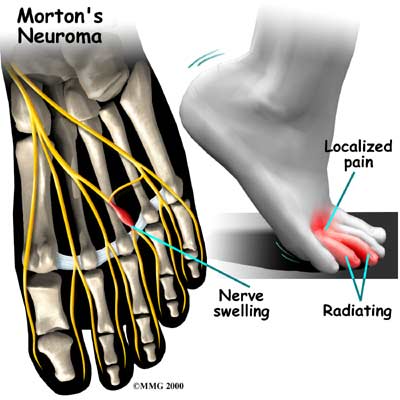
Morton's neuroma is a painful condition that affects the ball of your foot, most commonly the area between your third and fourth toes. Morton's neuroma may feel as if you are standing on a pebble in your shoe or on a fold in your sock.
It involves a thickening of the tissue around one of the nerves leading to your toes. In some cases, Morton's neuroma causes a sharp, burning pain in the ball of your foot. Your toes also may sting, burn or feel numb.
It may occur in response to irritation, injury or pressure. Common treatments include changing footwear or using arch supports. Sometimes corticosteroid injections or surgery may be necessary.
You may experience a feeling as if you are standing on a pebble in your shoe, or a burning pain in the ball of your foot that may radiate into your toes and there could be tingling or numbness in your toes.
A doctor is likely to order x-rays of your foot to rule out other causes for your pain like a stress fracture. There could be an Ultrasound done to reveal soft tissue abnormalities like neuroma or a MRI is also good at visualizing soft tissues.
Arch supports or orthotics help reduce pressure on the nerve and can prescribed by your doctor. Some people are helped by injecting steroids into the painful area.
Risk factors that appear to contribute to Morton's neuroma are high heels. Wearing high heeled shoes or shoes that are tight or ill-fitting can box in your feet and place pressure on your toes. People who have bunions, hammertoes, flatfeet or excessive flexibility are at higher risk of developing Morton's neuroma.
Try to avoid activities like jogging, or aerobic exercise or dancing that subject your feet to high impact and avoid wearing high heel or tight shoes. Choose shoes with a round toe box and extra depth.
So if you feel like you have pebbles in your shoes and have burning and pain in your toes, give Dr. T. F. Vail a call at 419-423-1888

Monday, December 6, 2010

Arthritis

According to mayoclinic.com, arthritis is inflammation of one or more of your joints, such as one or both knees or wrists, or a part of your spinal column. The two most common types of arthritis are osteoarthritis and rheumatoid arthritis. Joint pain and stiffness are the main symptoms of arthritis. Less common types of arthritis may be associated with conditions that also affect other parts of your body. For example, lupus can affect the kidneys and lungs, in addition to joints, while psoriasis is primarily a skin disease that sometimes also affects joints.

Rheumatoid arthritis causes chronic inflamation of the joints. It may also cause inflamation of tissue around the joints as well as the inflamation of other organs in the body.  Rheumatoid arthritis is an autoimmune disease.  Autoimmune diseases occur when the body's tissues mistakenly attacked by their own immune system.  Rheumatoid arthritis is typically a progressive illness that has the potential to cause joint destruction and functional disability.

Symptoms of rheumatoid arthritis include:
  • Stiffness. The joint is harder to use and might have a limited range of motion. Morning stiffness is one of the hallmark symptoms of rheumatoid arthritis. While many people with other forms of arthritis have stiff joints in the morning, it takes people with rheumatoid arthritis more than an hour (sometimes several hours) before their joints feel loose.
  • Swelling. Fluid enters into the joint and it becomes puffy; this also contributes to stiffness.
  • Pain. Inflammation inside a joint makes it sensitive and tender. Prolonged inflammation causes damage that also contributes to pain.
  • Redness and warmth. The joints may be somewhat warmer and more pink or red than the neighboring skin.
If you are experiencing any of the symptoms in your feet, schedule an appointment with your podiatrist. Also, visit our product store at vailfoot.com for great doctor approved products to relieve pain including Biofreeze gel. Biofreeze Pain Reliever breaks the cycle of pain with Cryotherapy, The Cold Method®.  Its cold application reduces the sensation of pain and inflammation, while the cold and re-warming stimulates the healing of tissue.

Saturday, December 4, 2010

Ganglion cyst


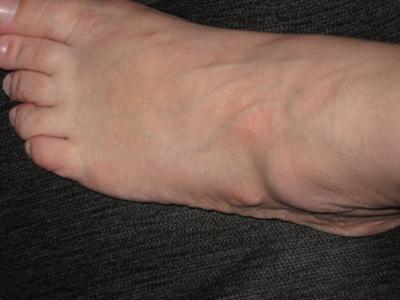
A ganglion cyst is a sac filled with a jellylike fluid that originates from a tendon sheath or joint capsule. The word ganglion means knot because it looks like a knot-like mass or lump that forms below the surface of the skin.
They are the most common benign soft-tissue masses. They mostly occur on the wrist but they also can develop on the foot usually on top. Sometimes they disappear altogether but will eventually reappear.
The exact cause of the ganglion is unknown. Most often it is from trauma.
A ganglion is associated with one or more of the following symptoms: A noticeable lump which can be the only symptom. There can be tingling or burning if the cyst is touching a nerve. There can be a dull pain or ache which means the cyst is pressing against a tendon or joint. Or difficulty wearing shoes because of irritation between the lump and the shoe.
To diagnose a ganglion the podiatrist will press a certain way and it should move freely underneath the skin. An x-ray or additional imaging may be needed.
Sometimes an aspiration is needed to drain the fluid and then inject a steroid into the mass to shrink it. But in many cases it will come back. Or the Doctor will just monitor it if the cyst does not cause any pain and does not interfere with walking. The Doctor may decide it is best to just monitor it over a period of time.
When other treatment options fail the cyst may need to be surgically removed. While the recurrence rate associated with surgery is much lower than the aspiration there are still cases where the ganglion returns.
So if you have noticed a lump on your foot and not sure what it is, give Dr. T. F. Vail a call at 419-423-1888 to have it checked before it gets to the point where it is painful.