A Step in the Right Direction

A Step in the Right Direction

Friday, August 3, 2012

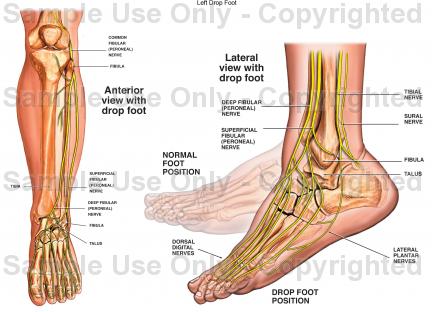
Foot Drop

Drop foot is a general term for difficulty lifting the front part of the foot. You may drag the front of your foot on the ground when you walk.

Foot drop isn't a disease but a sign of an underlying neurological, muscular or anatomical problem.

Sometimes foot drop is temporary. In other cases, foot drop is permanent. You may need to wear a brace on your ankle and foot to hold your foot in a normal position.

SYMPTOMS: You may experience difficulty lifting the front part of your foot, which sometimes is the only sign of foot drop. Dragging your foot on the floor as you walk. Slapping your foot down onto the floor with each step you take and raising your thigh when you walk, as if you were climbing stairs which is also called steppage gait. You may experience pain or weakness in the foot.

Foot drop usually affects only one foot. But depending on the underlying cause, however, its possible for both feet to be affected.

CAUSES: Foot drop is caused by weakness or paralysis of the muscles below the knee involved in lifting the front part of the foot. The underlying causes are varied. Often, neurological, muscular and anatomical problems overlap. .

Foot drop is usually diagnosed during a physical exam. An EMG and nerve conduction studies may be ordered. These tests measure electrical activity in the muscles and nerves.

TREATMENT: The treatment course depends on the underlying cause. If the cause is successfully treated, foot drop may improve or even disappear. If the underlying cause can't be treated, then this foot drop may be permanent.

Specific treatments for foot drop may include: Bracing or splints. A brace on your ankle and foot that fits into your shoe can help hold your foot in a normal position. Physical therapy would include exercises that strengthen your leg muscles and help you maintain the range of motion in your knee and ankle. Sometimes stimulating the nerve that lifts the foot when you step improves foot drop, especially in the case of foot drop caused by a stroke. In some cases, a small, battery-operated electrical stimulator is strapped to the leg just below the knee or is could be implanted in the leg.

If you have the above mentioned symptoms give Dr. T. F. Vail's office a call at 419-423-1888 for an evaluation.
On our website at www.vailfoot.com we do offer bracing for patients that have drop foot But it is advisable to first consult a podiatrist to see if this would be beneficial to you.

Friday, July 20, 2012

What is Arthritis?

According to the American Podiatric Medical Association, arthritis is the swelling and inflammation of the cartilage and lining of the joints.  The feet are a very complex part of your body and contain 33 joints that could be affected by arthritis.  There are several causes associated with arthritis including heredity, injuries (especially those that have been ignored), bacterial and viral infections, some prescription and illicit drugs can induce arthritis. If you are experience any of the symptoms in your feet listed below you should see a podiatrist.
  • Swelling in the joints
  • Recurring pain or tenderness in any joints
  • Redness or heat in a joint
  • Limited motion in a joint
  • Early morning stiffness
  • Skin changes, including rashes or growths
There are several different types of arthritis.  Osteoarthritis is the most common type of arthritis and is often referred to as "wear and tear" arthritis. Rheumatoid arthritis is another type of arthritis and may be the most severe.  Gout arthritis is caused by a build up of uric acid in the joints.  Psoriatic arthritis involves psoriasis, as it can affect the joints as well as the skin.  Traumatic arthritis is arthritis that is caused by an injury to a joint or joints.


There are several treatments for arthritis including physical therapy, exercise, and medication.  Biofreeze pain reliever can be purchased through our product store.  Its cold application reduces the pain and sensation associated while the cold and rewarming stimulates the healing of tissue. Foot functions may be controlled with shoe inserts or braces may be recommended.  Surgery may be used to replace damaged joints.  This will be used as a last resort. 

If you are experiencing pain in the joints of your feet that may be linked to arthritis, don't hesitate to make an appointment with a podiatrist.  Call our office at 419-423-1888 or visit our website to schedule an appointment.

Thursday, July 12, 2012

Do You Deal with Foot Pain Every Morning?


Plantar Fasciitis is one of the most common causes of heel pain and pain on the bottom of the foot.  The condition is caused by an inflammation of the plantar fascia, a band of tissue that runs from the heel to the toes.  Plantar Fasciitis is often worse in the mornings and may be a sharp, stabbing pain on the inside of the bottom of the heel.  The pain may subside during the day but can return after long periods of standing, walking, or getting up after long periods of sitting. 


Should I Call a Podiatrist?
If you experience any symptoms of Plantar Fasciitis, call a podiatrist and make an appointment.

What Causes Plantar Fasciitis?
Plantar Fasciitis is more likely to occur in people with excessively flat or high arches.  Sudden weight gain, shoes with poor arch support, a tight Achilles tendon, and long distance running may also increase your risk of developing Plantar Fasciitis. 

What are Treatments for Plantar Fasciitis?

  • Acetaminophen (Tylenol) or ibuprofen (Advil, Motrin) to reduce pain and inflammation
  • Heel and foot stretching exercises
  • Night splints to wear while sleeping to stretch the foot
  • Resting as much as possible for at least a week
  • Wearing shoes with good support and cushions
Other steps to relieve pain include:
  • Apply ice to the painful area. Do this at least twice a day for 10 - 15 minutes, more often in the first couple of days.
  • Try wearing a heel cup, felt pads in the heel area, or shoe inserts.
  • Use night splints to stretch the injured fascia and allow it to heal.
If these treatments do not work, your health care provider may recommend:
  • Wearing a boot cast, which looks like a ski boot, for 3-6 weeks. It can be removed for bathing.
  • Custom-made shoe inserts (orthotics)
  • Steroid shots or injections into the heel

Can Plantar Fasciitis be Prevented?
Plantar Fasciitis can be prevented by ensuring your Achilles tendon and calf muscle do not get too tight.  It is also important to wear shoes that properly support your feet.

Friday, June 29, 2012

Footcare during Hot Weather


Did you know your feet contain 250,000 sweat glands?  A fact you probably don't want to learn with the temperatures rising into the hundreds.  However, if your feet are always sweating like it's 100+ degrees outside, you may be suffering from hyperhydrosis. 

According to the APMA, excessive sweating of the feet is called hyperhydrosis.  The condition is more common in men than woman and is often paired with excessively sweaty palms.  The causes of hyperhydrosis are somewhat unknown but it is though to be heredity. 

Good foot hygeine is especially important for those with hyperhydrosis and in this very hot weather.  Here are some tips for keeping your feet clean.


  • Wash feet daily with an anti-bacterial soap, being sure to wash and dry between the toes. Try Dr. Smith's Deodorizing footwash, available through our online product store. The wash is made specifically for feet and can help reduce odor sometimes associated with excessive sweating.
  • Dry feet thouroughly and apply cornstarch or baby powder to soak up excess moisture.
  • Invest in socks that wick away moisture instead of trapping moisture in the sock.
  • Change your socks during the day.  Keep an extra pair at school or work and switch your socks mid-way through your day.
If your feet are sweating excessively, make an appointment with our doctor.  A podiatrist can help control this inconvenient condition.  Call our office at 419-423-1888 or visit our website, vailfoot.com, to request an appointment. 

Thursday, May 31, 2012

Foot Care For Seniors

It's normal for people to experience some foot problems as they age. But experts say that problems with feet can be the first sign of more serious medical conditions, particularly among older adults. Health problems, such as arthritis, diabetes, nerve issues, and circulatory disorders, may first be manifested in the feet. That is why it is important to pay attention to your feet and seek medical attention as soon as you notice a problem.

Here are some foot care tips for older adults:
  • Practice good foot care. Check your feet regularly or have a member of your family check them for you.
  • Keep blood circulating to your feet as much as possible. Do this by putting your feet up when you are sitting or lying down, stretching if you've had to sit for a long while, walking, having a gentle foot massage, or taking a warm foot bath.  Try Infracare socks these socks are embedded with Bio-materials that work on proven scientific principles to deliver infra-sound waves that warm up your feet.  If you are suffering from cold feet due to a medical condition succh as poor circulation, diabetes, Raynaud's deseas, use Infracare socks for 2 weeks and you will notice that your feet feel warmer when wearing them.
  • Wear comfortable shoes that fit well to prevent pressures that can lead to friction and infection and keep your foot structure properly aligned.
  • Avoid exposing your feet to cold temperatures.
  • Don't sit for long periods of time (especially with your legs crossed).
  • Don't smoke because it decreases blood supply and increases the chance of swelling and other circulatory problems.

Monday, August 8, 2011

Athlete's Foot

Athlete's foot is a fungal infection of the skin. It is also known as ringworm of the foot or tinea pedis.  Athlete's foot causes scaling, flaking, itching, and redness in the skin.  Other symptoms of athlete's foot include, blisters, cracked skin, and bacterial infection.  If left untreated, the condition can spread to other parts of the body. It is contagious and can be spread through public pools, showers, locker roms, and sometimes can be spread through sharing towels and footwear. 

To prevent contracting athlete's foot, hygiene is key.  Never go barefoot in a public place.  Always wear your shower or pool shoes in public areas.  Do not share towels, shoes, or socks with other people. There are several ways to treat athlete's foot.  The doctor may prescribe an oral anti-fungal medication or a topical anti-fungal medication. Tea tree, like the product below, may also be used as a natural treatment for the infection.


If you suspect you have athlete's foot, call our office or visit our website to request an appointment.

Wednesday, July 27, 2011

What Is Gout?


Picture from epharmapedia.com
 According to Mayoclinic.com, Gout is a form of arthritis charachterized by sudden severe attacks of pain, redness, and tenderness in joints.  This pain often occurs in the joint at the base of the big toe.  The pain of gout may wake you up in the middle of the night and give the sensation that your toe is on fire.  The joint may be hot, swollen, and extremely tender to the touch.

If you suffer from regular arthritis pain, visit our product store for pain relief products like biofreeze.  Its cold application reduces the sensation of pain and inflammation, while the cold and re-warming stimulates the healing of tissue.


Gout is caused by high levels of uric acid in your blood.  The high levels or uric acid create urate crystals that accumalate and your joint and cause pain and inflammation. 

Some people are at a higher risk for gout depending on age, sex, family history, and life style.  Men between the ages of forty and fifty are the most likely to develop gout.  Women's risk of gout increases after menopause.  A family history of gout also increases your chances of gout along with drinking excessive amounts of alcohol.

People who suffer from gout may develop more serious problems including recurring gout, advanced gout, and kidney stones.  Gout may only affect a person once but it can also come back several times a year.  Recurring gout can be prevented with medication.  If gout is left untreated, a person may develop advanced gout.  Advanced gout is characterized by deposits of urate crystals, called tophi, developing under the skin.  Tophi can become swollen and painful during gout attacks.  Gout can also cause kidney stones.  Kidney stones are caused from urate crystals collecting in the urinary tract.  Kidney stones may also be treated with medication. 

Joint fluid and blood tests may be used to diagnose gout. Once gout is diagnosed, it is usually treated with a medication.  Along with medication, a change in diet may also help.  This may include taking in more fluid, avoiding alchohol, a moderate amount of protein, and limiting the amount of meat, fish, and poultry.

If you suspect you have gout call our office at 419-423-1888 and schedule an appoinitment. You can also visit our website to learn more about our office and your feet.