
You should take your child to the foot doctor when you notice that his/her shoes are worn unevenly on the bottom.
Do you see any lumps or bumps on the feet?
If the child complains of pain in his/her feet or legs.
If you notice that the child trips or falls a lot
Or if there is a toenail problem. Children can get ingrown nails and they may not tell a parent until there is an infection.
So inspect your child's feet at least once a month to make sure there are no infections or lumps.
Friday, April 23, 2010

Saturday, April 17, 2010
Children's shoewear
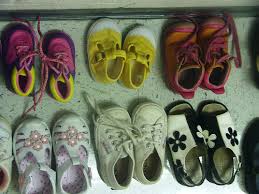
Many adult foot problems have origins while in childhood. So attention to footwear in children can minimize risk of problems in adults. The bones in children's feet are very pliable and if the shoes that they wear do not fit properly then that can lead to problems as adults. So prevent these problems by having your child's feet measured and shoes fit accordingly.
Never hand down shoes. Just because it fits one child does not mean it will fit the same way for another child. Also not to mention you can spread fungus by sharing shoes.
Friday, April 9, 2010
In-Toeing in Children
http://www.gettyimages.com/detail/85576844/Photographers-Choice
What is intoeing?
Most people's feet point straight ahead or outward. In some people, however, the feet point inward. This is called intoeing or pigeon toed. It is very common in young children. Most of the time it goes away without any treatment at all.
It usually doesn't cause serious problems, even if it doesn't go away by itself. It doesn't cause arthritis or clumsiness. Sometimes they have problems finding shoes that fit because of the curve of their feet. This is when parents consider treatment.
What causes intoeing? There are three causes: Metatarsus adductus, internal tibial torsion and excessive femoral anteversion.
METATARSUS ADDUCTUS: Is a curve in the foot. This is best seen if you look at the sole of your child's foot. The curve in the foot is probably caused before the baby is born when the feet are pressed into this position inside the uterus. 9 out of 10 children the feet will go straight as they grow up.
Stretching exercises will help the foot go straighter. Your doctor will instruct you on what to do.
INTERNAL TIBIAL TORSION: is a twist in the tibia bone. Parents notice this about the time the child begins to walk. Some inward twist of the tibial bone is normal. Usually this twist straightens out during the baby's first yr. Leg bones usually continue to grow straighter until the child is 6 to 8 yrs old.
Most doctors do not give any treatment for internal tibial torsion in young children.
EXCESS FEMORAL ANTEVERSION: This is an inward twist in the femur (thigh bone) This cause of intoeing usually shows up in children between 2 and 4 yrs of age. It can get worse during early childhood.
All babies are born with some inward twist of the thigh bone. It usually gets better during the first years of life. In babies and toddlers the ligaments and musles that connect the bones are tight. As they start walking these ligaments and muscles become looser which allows the hips to rotate more inward.
This usuall gets better by itself. In most children, the feet will point straight ahead or outward by the time they are 6 to 8 yrs old. Braces or shoe modifications will not help.
What is intoeing?
Most people's feet point straight ahead or outward. In some people, however, the feet point inward. This is called intoeing or pigeon toed. It is very common in young children. Most of the time it goes away without any treatment at all.
It usually doesn't cause serious problems, even if it doesn't go away by itself. It doesn't cause arthritis or clumsiness. Sometimes they have problems finding shoes that fit because of the curve of their feet. This is when parents consider treatment.
What causes intoeing? There are three causes: Metatarsus adductus, internal tibial torsion and excessive femoral anteversion.
METATARSUS ADDUCTUS: Is a curve in the foot. This is best seen if you look at the sole of your child's foot. The curve in the foot is probably caused before the baby is born when the feet are pressed into this position inside the uterus. 9 out of 10 children the feet will go straight as they grow up.
Stretching exercises will help the foot go straighter. Your doctor will instruct you on what to do.
INTERNAL TIBIAL TORSION: is a twist in the tibia bone. Parents notice this about the time the child begins to walk. Some inward twist of the tibial bone is normal. Usually this twist straightens out during the baby's first yr. Leg bones usually continue to grow straighter until the child is 6 to 8 yrs old.
Most doctors do not give any treatment for internal tibial torsion in young children.
EXCESS FEMORAL ANTEVERSION: This is an inward twist in the femur (thigh bone) This cause of intoeing usually shows up in children between 2 and 4 yrs of age. It can get worse during early childhood.
All babies are born with some inward twist of the thigh bone. It usually gets better during the first years of life. In babies and toddlers the ligaments and musles that connect the bones are tight. As they start walking these ligaments and muscles become looser which allows the hips to rotate more inward.
This usuall gets better by itself. In most children, the feet will point straight ahead or outward by the time they are 6 to 8 yrs old. Braces or shoe modifications will not help.
Saturday, April 3, 2010
Sever's Disease

Severs disease is probably the most frequent cause of heel pain in children. It occurs mostly in children between the ages of 8 and 14 yrs old but it can occur in younger children. It occurs equally in both boys and girls. Severs disease is characterized by activity-related pain that occurs on the back of the heel, where the Achilles tendon attaches on the heel. They may have swelling in the area, and tenderness to the touch. Usually children involved in sports experience this problem.
Usually ice and rest is recommended along with orthotics.
Friday, March 26, 2010
Children's Feet

There is no such thing as normal foot pain for a child. When a child complains of foot pain the parents take them to the pediatrician and he just says "he will outgrow it." Sound familiar? The most common pain is when he or she wakes up in the middle of night with a leg cramp. This is commonly called "growing pain." This should not be a concern if they occur infrequently. When it occurs, have the child stand and "walk it off." If it is a nightly occurrence, like several times a week, you should visit your doctor.
But it is a bigger concern if the child has pain when standing, walking, or running. These can be caused by biomechanical imbalance that cause instability of the leg and foot. This is when a visit to a podiatrist is highly recommended. Usually a custom orthotic will be prescribed.
Saturday, March 20, 2010
Flat Feet and Children


Parents often wonder if their child's flat feet should be of a concern. Most children have no symptoms but they may appear to walk or run awkwardly. There could be a complaint of pain or cramping in their feet, legs or knees. Parents may think these are just growing pains. But growing should never hurt. Any pain or difficulty with a child's feet should be evaluated by a podiatrist.
Ignoring your child's flat feet can result in lasting damage that could continue to cause problems throughout his life.
Saturday, March 13, 2010
My Dr. says I have a stress fracture in my foot. What is that?
A stress fracture occurs when muscles become fatigued or overloaded and cannot absorb the stress and shock of repeated impact. Fatigued muscles transfer that stress to bone that is nearby and you have the result of a small crack or fracture, in the bone.
Stress fractures in the foot are usually caused by overuse. They can also be caused by repeated pounding on a hard surface, like running on concrete. Improper footwear during sports activities can contribute also.
Women seem to be at a greater risk of stress fractures because of osteoporosis (thinning of the bones). This results in decreased bone density which is a risk for stress fractures.
The best treatment for a stress fracture is rest. If rest isn't followed through then chronic problems such as a larger and more persistent stress fracture can develop. Re-injury may result in a chronic foot problem and the fracture might never heal properly. At the Advanced Footcare Clinic we usually put a patient with a stress fracture into a soft cast (not a fiberglass cast) and an MC Walker boot to help immobilize (or rest) the foot.
A stress fracture occurs when muscles become fatigued or overloaded and cannot absorb the stress and shock of repeated impact. Fatigued muscles transfer that stress to bone that is nearby and you have the result of a small crack or fracture, in the bone.
Stress fractures in the foot are usually caused by overuse. They can also be caused by repeated pounding on a hard surface, like running on concrete. Improper footwear during sports activities can contribute also.
Women seem to be at a greater risk of stress fractures because of osteoporosis (thinning of the bones). This results in decreased bone density which is a risk for stress fractures.
The best treatment for a stress fracture is rest. If rest isn't followed through then chronic problems such as a larger and more persistent stress fracture can develop. Re-injury may result in a chronic foot problem and the fracture might never heal properly. At the Advanced Footcare Clinic we usually put a patient with a stress fracture into a soft cast (not a fiberglass cast) and an MC Walker boot to help immobilize (or rest) the foot.
Subscribe to:
Posts (Atom)

 Posts
Posts


