A Step in the Right Direction

A Step in the Right Direction

Tuesday, December 18, 2012

What is a Bunion?


bunion is a bone deformity caused by an enlargement of the joint at the base and side of the big toe (metatarsophalangeal joint). Bunions form when the toe moves out of place. The enlargement and its protuberance cause friction and pressure as they rub against footwear. Over time, the movement of the big toe angles in toward the other toes, sometimes overlapping a third toe (known asHallux Valgus). The growing enlargement or protuberance then causes more irritation or inflammation. In some cases, the big toe moves toward the second toe and rotates or twists, which is known as Hallus Abducto Valgus. Bunions can also lead to other toe deformities, such as hammertoe.
Many people with bunions suffer from discomfort and pain from the constant irritation, rubbing, and friction of the enlargement against shoes. The skin over the toe becomes red and tender. Because this joint flexes with every step, the bigger the bunion gets, the more it hurts to walk. Over time, bursitis or arthritismay set in, the skin on the bottom of the foot may become thicker, and everyday walking may become difficult—all contributing to chronic pain.
Wearing shoes that are too tight is the leading cause of bunions. Bunions are not hereditary, but they do tend to run in families, usually because of a faulty foot structure. Foot injuries, neuromuscular problems, flat feet, and pronated feet can contribute to their formation. It is estimated that bunions occur in 33 percent of the population in Western countries.
Treatment for Bunions
Because they are bone deformities, bunions do not resolve by themselves. The goal for bunion treatment is twofold: first, to relieve the pressure and pain cause by irritations, and second to stop any progressive growth of the enlargement. Commonly used methods for reducing pressure and pain caused by bunions include:
  • The use of protective padding, often made from felt material, to eliminate the friction against shoes and help alleviate inflammation and skin problems.
  • Removal of corns and calluses on the foot.
  • Changing to carefully-fitted footwear designed to accommodate the bunion and not contribute toward its growth.
  • Orthotic devices—both over-the-counter and custom made—to help stabilize the joint and place the foot in the correct position for walking and standing.
  • Exercises to maintain joint mobility and prevent stiffness or arthritis.
  • Splints for nighttime wear to help the toes and joint align properly. This is often recommended for adolescents with bunions, because their bone development may still be adaptable.
Surgical Treatment
Depending on the size of the enlargement, misalignment of the toe, and pain experienced, conservative treatments may not be adequate to prevent progressive damage from bunions. In these cases, bunion surgery, known as a bunionectomy, may be advised to remove the bunion and realign the toe.

Friday, August 3, 2012

Foot Drop

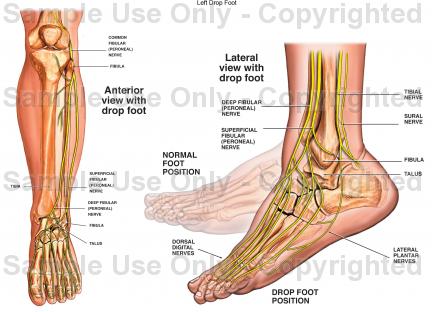
Drop foot is a general term for difficulty lifting the front part of the foot. You may drag the front of your foot on the ground when you walk.

Foot drop isn't a disease but a sign of an underlying neurological, muscular or anatomical problem.

Sometimes foot drop is temporary. In other cases, foot drop is permanent. You may need to wear a brace on your ankle and foot to hold your foot in a normal position.

SYMPTOMS: You may experience difficulty lifting the front part of your foot, which sometimes is the only sign of foot drop. Dragging your foot on the floor as you walk. Slapping your foot down onto the floor with each step you take and raising your thigh when you walk, as if you were climbing stairs which is also called steppage gait. You may experience pain or weakness in the foot.

Foot drop usually affects only one foot. But depending on the underlying cause, however, its possible for both feet to be affected.

CAUSES: Foot drop is caused by weakness or paralysis of the muscles below the knee involved in lifting the front part of the foot. The underlying causes are varied. Often, neurological, muscular and anatomical problems overlap. .

Foot drop is usually diagnosed during a physical exam. An EMG and nerve conduction studies may be ordered. These tests measure electrical activity in the muscles and nerves.

TREATMENT: The treatment course depends on the underlying cause. If the cause is successfully treated, foot drop may improve or even disappear. If the underlying cause can't be treated, then this foot drop may be permanent.

Specific treatments for foot drop may include: Bracing or splints. A brace on your ankle and foot that fits into your shoe can help hold your foot in a normal position. Physical therapy would include exercises that strengthen your leg muscles and help you maintain the range of motion in your knee and ankle. Sometimes stimulating the nerve that lifts the foot when you step improves foot drop, especially in the case of foot drop caused by a stroke. In some cases, a small, battery-operated electrical stimulator is strapped to the leg just below the knee or is could be implanted in the leg.

If you have the above mentioned symptoms give Dr. T. F. Vail's office a call at 419-423-1888 for an evaluation.
On our website at www.vailfoot.com we do offer bracing for patients that have drop foot But it is advisable to first consult a podiatrist to see if this would be beneficial to you.

Friday, July 20, 2012

What is Arthritis?

According to the American Podiatric Medical Association, arthritis is the swelling and inflammation of the cartilage and lining of the joints.  The feet are a very complex part of your body and contain 33 joints that could be affected by arthritis.  There are several causes associated with arthritis including heredity, injuries (especially those that have been ignored), bacterial and viral infections, some prescription and illicit drugs can induce arthritis. If you are experience any of the symptoms in your feet listed below you should see a podiatrist.
  • Swelling in the joints
  • Recurring pain or tenderness in any joints
  • Redness or heat in a joint
  • Limited motion in a joint
  • Early morning stiffness
  • Skin changes, including rashes or growths
There are several different types of arthritis.  Osteoarthritis is the most common type of arthritis and is often referred to as "wear and tear" arthritis. Rheumatoid arthritis is another type of arthritis and may be the most severe.  Gout arthritis is caused by a build up of uric acid in the joints.  Psoriatic arthritis involves psoriasis, as it can affect the joints as well as the skin.  Traumatic arthritis is arthritis that is caused by an injury to a joint or joints.


There are several treatments for arthritis including physical therapy, exercise, and medication.  Biofreeze pain reliever can be purchased through our product store.  Its cold application reduces the pain and sensation associated while the cold and rewarming stimulates the healing of tissue. Foot functions may be controlled with shoe inserts or braces may be recommended.  Surgery may be used to replace damaged joints.  This will be used as a last resort. 

If you are experiencing pain in the joints of your feet that may be linked to arthritis, don't hesitate to make an appointment with a podiatrist.  Call our office at 419-423-1888 or visit our website to schedule an appointment.

Thursday, July 12, 2012

Do You Deal with Foot Pain Every Morning?


Plantar Fasciitis is one of the most common causes of heel pain and pain on the bottom of the foot.  The condition is caused by an inflammation of the plantar fascia, a band of tissue that runs from the heel to the toes.  Plantar Fasciitis is often worse in the mornings and may be a sharp, stabbing pain on the inside of the bottom of the heel.  The pain may subside during the day but can return after long periods of standing, walking, or getting up after long periods of sitting. 


Should I Call a Podiatrist?
If you experience any symptoms of Plantar Fasciitis, call a podiatrist and make an appointment.

What Causes Plantar Fasciitis?
Plantar Fasciitis is more likely to occur in people with excessively flat or high arches.  Sudden weight gain, shoes with poor arch support, a tight Achilles tendon, and long distance running may also increase your risk of developing Plantar Fasciitis. 

What are Treatments for Plantar Fasciitis?

  • Acetaminophen (Tylenol) or ibuprofen (Advil, Motrin) to reduce pain and inflammation
  • Heel and foot stretching exercises
  • Night splints to wear while sleeping to stretch the foot
  • Resting as much as possible for at least a week
  • Wearing shoes with good support and cushions
Other steps to relieve pain include:
  • Apply ice to the painful area. Do this at least twice a day for 10 - 15 minutes, more often in the first couple of days.
  • Try wearing a heel cup, felt pads in the heel area, or shoe inserts.
  • Use night splints to stretch the injured fascia and allow it to heal.
If these treatments do not work, your health care provider may recommend:
  • Wearing a boot cast, which looks like a ski boot, for 3-6 weeks. It can be removed for bathing.
  • Custom-made shoe inserts (orthotics)
  • Steroid shots or injections into the heel

Can Plantar Fasciitis be Prevented?
Plantar Fasciitis can be prevented by ensuring your Achilles tendon and calf muscle do not get too tight.  It is also important to wear shoes that properly support your feet.

Friday, June 29, 2012

Footcare during Hot Weather


Did you know your feet contain 250,000 sweat glands?  A fact you probably don't want to learn with the temperatures rising into the hundreds.  However, if your feet are always sweating like it's 100+ degrees outside, you may be suffering from hyperhydrosis. 

According to the APMA, excessive sweating of the feet is called hyperhydrosis.  The condition is more common in men than woman and is often paired with excessively sweaty palms.  The causes of hyperhydrosis are somewhat unknown but it is though to be heredity. 

Good foot hygeine is especially important for those with hyperhydrosis and in this very hot weather.  Here are some tips for keeping your feet clean.


  • Wash feet daily with an anti-bacterial soap, being sure to wash and dry between the toes. Try Dr. Smith's Deodorizing footwash, available through our online product store. The wash is made specifically for feet and can help reduce odor sometimes associated with excessive sweating.
  • Dry feet thouroughly and apply cornstarch or baby powder to soak up excess moisture.
  • Invest in socks that wick away moisture instead of trapping moisture in the sock.
  • Change your socks during the day.  Keep an extra pair at school or work and switch your socks mid-way through your day.
If your feet are sweating excessively, make an appointment with our doctor.  A podiatrist can help control this inconvenient condition.  Call our office at 419-423-1888 or visit our website, vailfoot.com, to request an appointment. 

Thursday, May 31, 2012

Foot Care For Seniors

It's normal for people to experience some foot problems as they age. But experts say that problems with feet can be the first sign of more serious medical conditions, particularly among older adults. Health problems, such as arthritis, diabetes, nerve issues, and circulatory disorders, may first be manifested in the feet. That is why it is important to pay attention to your feet and seek medical attention as soon as you notice a problem.

Here are some foot care tips for older adults:
  • Practice good foot care. Check your feet regularly or have a member of your family check them for you.
  • Keep blood circulating to your feet as much as possible. Do this by putting your feet up when you are sitting or lying down, stretching if you've had to sit for a long while, walking, having a gentle foot massage, or taking a warm foot bath.  Try Infracare socks these socks are embedded with Bio-materials that work on proven scientific principles to deliver infra-sound waves that warm up your feet.  If you are suffering from cold feet due to a medical condition succh as poor circulation, diabetes, Raynaud's deseas, use Infracare socks for 2 weeks and you will notice that your feet feel warmer when wearing them.
  • Wear comfortable shoes that fit well to prevent pressures that can lead to friction and infection and keep your foot structure properly aligned.
  • Avoid exposing your feet to cold temperatures.
  • Don't sit for long periods of time (especially with your legs crossed).
  • Don't smoke because it decreases blood supply and increases the chance of swelling and other circulatory problems.

Monday, August 8, 2011

Athlete's Foot

Athlete's foot is a fungal infection of the skin. It is also known as ringworm of the foot or tinea pedis.  Athlete's foot causes scaling, flaking, itching, and redness in the skin.  Other symptoms of athlete's foot include, blisters, cracked skin, and bacterial infection.  If left untreated, the condition can spread to other parts of the body. It is contagious and can be spread through public pools, showers, locker roms, and sometimes can be spread through sharing towels and footwear. 

To prevent contracting athlete's foot, hygiene is key.  Never go barefoot in a public place.  Always wear your shower or pool shoes in public areas.  Do not share towels, shoes, or socks with other people. There are several ways to treat athlete's foot.  The doctor may prescribe an oral anti-fungal medication or a topical anti-fungal medication. Tea tree, like the product below, may also be used as a natural treatment for the infection.


If you suspect you have athlete's foot, call our office or visit our website to request an appointment.

Wednesday, July 27, 2011

What Is Gout?


Picture from epharmapedia.com
 According to Mayoclinic.com, Gout is a form of arthritis charachterized by sudden severe attacks of pain, redness, and tenderness in joints.  This pain often occurs in the joint at the base of the big toe.  The pain of gout may wake you up in the middle of the night and give the sensation that your toe is on fire.  The joint may be hot, swollen, and extremely tender to the touch.

If you suffer from regular arthritis pain, visit our product store for pain relief products like biofreeze.  Its cold application reduces the sensation of pain and inflammation, while the cold and re-warming stimulates the healing of tissue.


Gout is caused by high levels of uric acid in your blood.  The high levels or uric acid create urate crystals that accumalate and your joint and cause pain and inflammation. 

Some people are at a higher risk for gout depending on age, sex, family history, and life style.  Men between the ages of forty and fifty are the most likely to develop gout.  Women's risk of gout increases after menopause.  A family history of gout also increases your chances of gout along with drinking excessive amounts of alcohol.

People who suffer from gout may develop more serious problems including recurring gout, advanced gout, and kidney stones.  Gout may only affect a person once but it can also come back several times a year.  Recurring gout can be prevented with medication.  If gout is left untreated, a person may develop advanced gout.  Advanced gout is characterized by deposits of urate crystals, called tophi, developing under the skin.  Tophi can become swollen and painful during gout attacks.  Gout can also cause kidney stones.  Kidney stones are caused from urate crystals collecting in the urinary tract.  Kidney stones may also be treated with medication. 

Joint fluid and blood tests may be used to diagnose gout. Once gout is diagnosed, it is usually treated with a medication.  Along with medication, a change in diet may also help.  This may include taking in more fluid, avoiding alchohol, a moderate amount of protein, and limiting the amount of meat, fish, and poultry.

If you suspect you have gout call our office at 419-423-1888 and schedule an appoinitment. You can also visit our website to learn more about our office and your feet. 

Saturday, April 30, 2011

foot drop

Foot drop sometimes called drop foot, is a general term for difficulty lifting the front part of the foot. If you have foot drop, you may drag the front of your foot on the ground when you walk. Foot drop isn't a disease. Rather, foot drop is a sign of an underlying neurological , muscular or anatomical problem.
Sometimes foot drop is temporary, in other cases, foot drop is permanent. If you have foot drop, you may need to wear a brace on your a
nkle and foot to hold your foot in a normal position.

Symptoms may include: Difficulty lifting the front part of your foot, which is sometimes the only sign of foot drop. (2) dragging your foot on the floor as you walk. (3) Slapping your foot down onto the floor with each step you take. (4) Raising your thigh when you walk, as
if you were climbing stairs. (5) Pain, weakness or numbness in the foot.

Foot drop is caused by weakness or paralysis of the muscles below the knee involved in lifting the front part of the foot. The underlying causes of foot drop are varied. Often, neurological, muscular and anatomical problems overlap.

Treatment for foot drop depends on the underlying cause. If the underlying cause is successfully treated, foot drop may improve or even disappear. If the underlying cause cannot be treated, then it may be permanent.
Bracing or splints that fits into your shoe can help hold your foot in a normal position. Physical therapy including exercises that strengthen your leg muscles and help you maintain the range of motion in your knee and ankle may improve gait problems associated with drop foot. Surgery would involve infusing ankle or foot bones or that transfers tendons to stronger leg muscles may be helpful to improve walking difficulties.
www.vailfoot.com is our website that you can go to look at various braces that would help you if you have drop foot. This is an example of the Exoform ankle brace that helps to support your ankle. It is best to get professional advice as to what kind of brace would be best for you. Give Dr. T. F. Vail's office a call at 419-423-1888 to schedule an appointment if you are bothered by drop foot.

Sunday, April 10, 2011

Plantar warts


Warts are small, usually painless growths on the skin caused by a virus called human papillomavirus (HPV). They are generally harmless. However, warts can be disfiguring and embarrassing, and occasionally they itch or hurt.

There are many types of warts, but we will discuss the
PLANTAR wart. They are found on the soles of the feet.

The typical wart is a raised round or oval growth on the skin with a rough surface. They tend to cause no discomfort unless they are in areas of repeated pressure. Large numbers of plantar warts on the foot may cause difficulty walking or running.

Some warts will disappear without treatment, although it can sometimes take a couple of years. Treated or not, warts that go away often reappear. All warts can spread from one part of your body to another.

Symptoms: Abnormally dark or light skin surrounding the lesion.
Rough growth or lesions on soles of feet-flat to slightly raised-painful to pressure

If the doctor is unsure if it is a wart or not a biopsy may be done to confirm that it isn't something else.

At Advanced Footcare Clinic we recommend using a paste that contains 60% salicytic acid. This is the highest amount of acid that you can obtain without a prescription.

So if you have been bothered by plantar warts and just cannot get rid of them call Dr. T. F. Vail, DPM at 419-423-1888 for an appointment.

Or on our webstore www.vailfoot.com there are products that contain the salicytic acid also. If the warts are in an area that causes discomfort when walking we have offloading pads that can help take the pressure off the area.

Sunday, April 3, 2011

Nail Fungus

Nail fungus, or onychomycosis, is a condition that occurs when a microscopic fungus enters a toenail. It can also occur in fingernails but is more common in toenails.
Anyone can get nail fungus, but infections are more common in people over the age of 60 and people who have a weakened immune system.

Usually, nail fungus occurs when it enters the nail through a small trauma like a cut or break in the nail. Nail fungus is not caused by poor hygiene. It can spread from person to person. A warm, wet place like a locker room is a good place for fungus to grow.

Your nail will look thick and discolored. Uncommonly, you may feel pain in your toes.

Your doctor may be able to tell if you have fungus by looking carefully at your nails. He will do a scraping of some nail and tissue from under your nail and send it to a lab to determine for certain what kind of infection you have.

Treatment of nail fungus may include oral antifungal drug like Lamisil or a topical antifungal. Removal of the infected nail can be performed. At Advanced Footcare Clinic we offer to our patients a topical antifungal called Formula 3 which has been beneficial to our patients. It is not a prescription and is only sold in podiatry offices.

To prevent getting nail fungus infection you should avoid walking barefoot in public areas like locker rooms. Keep the inside of your shoes dry and change your socks frequently. If you have sweaty feet you should wear socks that wick away the moisture from your feet. At Advanced Footcare Clinic we offer to our patients socks that contain charcoal fibers that wick away the moisture from your feet. Wear proper fitting shoes that are long enough and the toe box is wide enough that isn't putting pressure on your toes. Use absorbent, antifungal powder.

On our website www.vailfoot.com we offer fungal soap which contains tea tree oil which is a natural antifungal in it that washes the fungus and bacteria off your skin when you use it in the shower.

Also we are offering to our patients a laser procedure that "zaps" away common fungus that causes the discolored nails. It is a Noveon laser and has been been very successful.

But people must understand that once they are successful in getting rid of the fungus that they still have to follow a good hygiene program, including antifungal spray for shoes, not going barefoot and keeping feet clean and dry.

Sunday, March 20, 2011

Hammertoes

A hammertoe is a term that is commonly used to describe any type of toe deformity.
The deformity usually exists in one toe at the proximal interphalangeal joint or the base of the toe. It points upward and the end of the toe points down-and looks just like a hammer.

The symptoms are usually first noticed when a corn develops on top of the toe and becomes painful, usually when wearing tight shoes. Initially a hammer toe is usually flexible, bu
t when longstanding it becomes more rigid.

Hammertoes can be due to a number of things. Several factors are known to increase the risk of developing hammer toes: Some people are just structurally prone to develop hammertoes. (2) tight footwear is an important factor in the cause of hammer toes as well as providing the pressure that causes the symptoms.

A number of approaches can be undertaken to manage a hammer toe: It is important to have the shoes that are worn checked to make sure they are wide enough. You want enough space in the toe box to allow room for the toes without any excessive pressure. If a corn is present, this will need to be treated. If the toe is still flexible, it may be possible to use splints to try and correct the toe. Padding is often used to get pressure off the toe to help the symptoms. If
conservative treatment is unsuccessful at helping the symptoms, surgery is often a good option.

Surgery to correct for a hammertoe may be performed as a same day procedure. There are several different types of procedures that can be used depending on the foot structure and if the hammertoe is flexible or rigid.
On our website www.vailfoot.com we have numerous products that can help with hammertoes.

A budin splint is constructed of comfortable, but sturdy material that extend the hammertoe, allowing it to lie straight. It will help prevent the toe from becoming worse.

So if you have a hammertoe that is beginning to give you problems, give Dr. T. F. Vail's office a call at 419-423-1888 to set up an appointment.

Saturday, March 12, 2011

Calluses and corns

Calluses are a thickening of the surface layer of the skin. The medical term for corns and calluses is hyperkeratosis. A callus refers to a more diffuse, flattened area of thick skin while a corn is a thick, localized area that usually has a conical or circular shape. Corns, also known as helomas, sometimes have a dry, waxy, or translucent appearance.

Corns and calluses occur on parts of the feet and sometimes the fingers. Corns can be painful to walk on, even when they are
small. Common locations for corns are on the sole, over the metatarsal arch-or the ball of the foot. They can be found on the outside of the fifth (small or pinky) toe, where it rubs against the shoe and between the fourth and fifth toes. Unlike other corns that are firm and flesh-colored, corns between the toes are often whitish and messy. They are sometimes called "soft corns". in contrast to the more common "hard corns".

Hyperkeratosis simply means thickening of the skin. This thickening occurs as a natural defense mechanism that strengthens the skin in areas of friction or pressure. Hammer toe or other toe deformities can lead to corn or callus formation as can bony prominences in the feet. Footwear that is too tight or that exerts friction at specific points can also cause skin thickening that le
ads to corns and calluses. Abnormalities in gait or movement that result in increased pressure to specific areas can also be the cause.

You should wear supportive shoes with a wide enough toe box. Moisturizing creams with urea help to exfoliate the thickened skin. By no means should you use a razor to trim away the thick skin, especially if you are diabetic.

At the Advanced Footcare Clinic we recommend Gormel 20. It has 20 percent urea which helps to exfoliate and moisturize the callus. This is the highest percent of urea that can be purchased at our office without a prescription.

If you are experiencing painful corns or calluses and have just can't seem to find anything that can help you give the office of Dr. T F. Vail, DPM a call at 419-423-1888 to set up an
appointment.

On our website: www.vailfoot.com we have many products to help with corns and calluses. Dr. Jill's felt pad helps to take the pressure off the area so that it is not so painful to walk.

Sunday, March 6, 2011

tarsal tunnel

Tarsal Tunnel is a space in the foot formed between bones and overlying fibrous tissue. Within the tarsal tunnel lies a nerve called the posterior tibial nerve.

Tarsal tunnel syndrome results when the posterior tibial nerve is compressed within the tarsal tunnel. This is very similar to carpal tunnel syndrome that you can have in your wrist. Both of these conditions result when a nerve is pinched within a small space.

When the posterior tibial nerve is compressed in the tarsal tunnel, patients commonly complain of numbness over the bottom of the foot, as well as complaints of pain, burning and tingling over the base of the foot and heel. It can be confused with plantar fascitis.

The cause of tarsal tunnel is unknown in most cases, but can be the result of fractures, bone spurs, ganglion and other benign tumors or foot deformities.

Treatment can consist of anti-inflammatory medications and possibly injection of cortisone into the area around the nerve. Orthotics can help to relieve the symptoms.

Surgery may be indicated where an incision is made to open up the tarsal tunnel and decrease pressure on the posterior tibial nerve. This procedure is similar to a carpal tunnel release in the hand.

If you are experiencing burning or numbness in your feet, a podiatrist should be consulted to make sure of what is causing the problem. To contact the office Dr. T. F. Vail, DPM, call 419-423-1888
On our website at www.vailfoot.com we offer powerstep insoles if you do not have custom-made
orthotics.