A Step in the Right Direction

A Step in the Right Direction

Saturday, October 23, 2010

ankle pain


When you tell your doctor that your ankle hurts one of the first questions he will ask is if you remember any injury that you may have done, for instance stepping in a hole or twisting your ankle.


This article is dealing with ankle pain that is the result of nothing more than abnormal biomechanics of the foot. Biomechanics is defined as the study of the mechanics of a living body, especially of the forces exerted by muscles and gravity on the skeletal structure.

The ankle joint is considered a hinge joint where the talus bone of the foot sits directly under the tibia bone and is anchored on the side by the end of the fibula bone to form the ankle joint.


One of the biomechanical faults that many people exhibit is over-pronation. This is where the foot "rolls in" The problem with this is that the excessive pronation forces the talus bone to abnormally sit in the joint space. Over time this will cause a premature erosion of the joint.


Treatment is simple. reduce the over-pronation. This can be done with an orthotic. Within a day or so of wearing the orthotics the patient will begin to notice improvement. Sometimes an Arizona brace may be prescribed. It just depends on the patients degree of pain and pronation.


If you are experiencing ankle pain just give our office a call at 419-423-1888 to find out what can be done for your situation


You can also check our website http://www.vailfoot.com/ for powerstep insoles. They are not custom made for you but they will help til you are able to get the custom made orthotics.

Saturday, October 16, 2010

Swollen feet/ankles

Swollen feet/ankles is a condition also known as edema is due to excessive buildup of fluids. It can lead to increase in weight.

Slight swelling is common warm summer months and if your job involves a lot of standing or walking. But if you experience persistent swelling, or swelling that damages your skin causing ulcers then is when you need to see a podiatrist. If you have swelling with shortness of breath then you need to contact your family doctor.

CAUSES: gravity pulls fluids to feet and ankles causing swelling. A serious condition of swelling can be caused by kidney or heart or liver problems. A poor diet with high content of sodium can cause swelling. Also if you are taking birth control pills or hormone replacement medication, if you are pregnant, experiencing PMS or varicose veins, laxative abuse or diuretic abuse can all contribute to swelling.

Can swelling in your feet be treated? Yes but it depends on the cause of the swelling. To help with the swelling you should try elevating your legs above the level of heart and wear support stockings.

TIPS to decrease the swelling- cut back on sodium, drink lots of water, elevate your feet, do not abuse laxatives, exercise and avoid standing in one place, and avoid long periods of sitting. So if you do much international flying it is very important to get up and exercise legs and ankles.

Excessive swelling can cause ulcerations in feet or ankles. If you have ulcerations in feet then is when a podiatrist should be visited.

At our website http://www.vailfoot.com/ we offer support stockings that can help with mild swelling.


Sunday, October 10, 2010

hallux rigidus


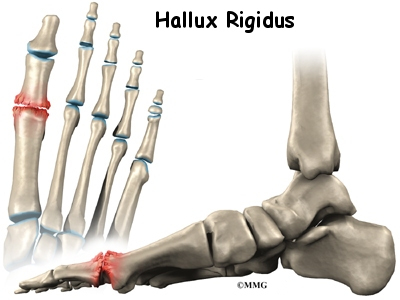
Hallux rigidus is a disorder of the joint located at the base of the big toe. It causes pain and stiffness in the joint and with time it gets increasingly harder to bend the toe. Hallux means the big toe and rigidus indicates the toe is rigid and cannot move. It is a form of degenerative arthritis.


It can be very troubling and even disabling since we use the big toe whenever we walk, stoop down, climb up or even stand.


Common causes of hallux rigidus comes from structural abnormalities of the foot that can lead to osteoarthritis in the big toe joint. This type of arthritis often develops in people who have defects that change the way their foot and big toe functions.

Those with fallen arches or excessive pronation of the ankles are susceptible to developing hallux rigidus.


People who do a lot of squatting or stooping put a lot of stress on the big toe and can develop hallux rigidus. Also can be the result from an injury such as stubbing your toe .


Symptoms: Pain and stiffness in the big toe during use. (2) pain and stiffness aggravated by cold damp weather. (3) difficulty with certain activities like running or squatting.


Diagnosis: The sooner this is diagnosed the easier it is to treat. So the best time to see a podiatrist is when you first notice symptoms. If you wait til a bone spur develops your condition will likely be harder to manage.


The podiatrist will examine your feet and move the toe to determine its range of motion and x-rays will help determine how much arthritis is present as well as to evaluate any bone spurs.


Non-surgical treatment: Shoe modifications: Shoes with a large toe box puts less pressure on your toe. Stiff or rocker-bottom soles may also be recommended

(2) Orthotics will improve foot function

(3) Medications such as nonsteroidal anti-inflammatory drugs such as ibuprofen may be recommended to reduce pain and inflammation.

(4) Injection of corticosteriods may reduce inflammation and pain.


If you have a big toe that is causing you problems give Dr. Thomas F. Vail's office a call at 419-423-1888 to set up an appointment to see if your pain is due to hallux rigidus

You can try powersteps from our website store that would help to control your foot and take pressure off the area of pain. http://www.vailfoot.com/


Saturday, September 25, 2010

Sesamoid bones in the foot


The sesamoids are two pea-shaped bones located in the ball of the foot beneath the big toe joint.

Sesamoids help the big toe move normally and provide leverage when the big toe "pushes off" during walking and running. They also serve as a weight-bearing surface for the first metatarsal bone to absorb the weight placed on the ball of the foot when walking, running and jumping.


Sesamoid injuries can involve the bones, tendons, and/or surrounding tissue in the joint. They are often associated with activities requiring increased pressure on the ball of the foot, such as running, basketball, football, golf, tennis and ballet. In addition, people with high arches are at risk for developing sesamoid problems. Frequent wearing of high-heeled shoes can also be a contributing factor.


To diagnosis a sesamoid injury, the podiatrist will examine the foot, focusing on the big toe joint. The Doctor will press on the big toemove it up and down and may assess the patient's walking and evaluate the wear pattern on the patient's shoes. X-rays are ordered, and in some cases, advanced imaging studies may be ordered.


Non-surgical treatment for sesamoid injuries of the foot may include one or more of the following options, depending on the type of injury and degree of severity: Padding, strapping or taping: A pad may be placed in the shoe to cushion the inflamed sesamoid area. Immobiliztion: the foot may be placed in a cast or removable walking cast. Crutches may be used to prevent weight bearing. Oral medications: nonsteroidal anti-inflammatory drugs such as ibuprofen is helpful in reducing the pain. Physical therapy: this could be exercises, strengthening and ultrasound. Steroid injections: cortisone is injected into the joint to reduce inflammation. Orthotics: custom orthotics that fit into the shoe may be prescribed for long-term treatment of sesamoiditis to balance the pressure placed on the ball of the foot.


If the above treatment does not help then surgery may be required.


So if you are experiencing pain in the ball of your foot under the great toe give Dr. T. Vail a call for an appointment to see if this is the reason for your pain. 419-423-1888. On our website : http://www.vailfoot.com/ visit our online store and there are Dr. Jill's Dancer pads that will help to cushion the inflamed sesamoid bones.

Saturday, September 18, 2010

Blisters

Blisters aresmall swelling of the skin that contains watery fluid. They are caused by friction. The body responds to the friction by producing fluid. The fluid builds up beneath the part of the skin being rubbed, causing pressure and pain.

Blisters occur when feet get hot, sweaty and socks stick to the feet. The sock and foot then rub against each other and the inside of the shoe. Fluid fills up a space between layers of skin to protect the area, like a small balloon. That is how a blister forms.

Blisters are a common problem with athletes wearing new shoes. Also runners and walkers who participate in long events like marathons.

If a blister is red, leaking yellow fluid or has red lines near the blister see a podiatrist right away since this is symptoms of infection.

The most common causes of foot blisters are: heat, moisture and friction.

Some ways to prevent blisters are: wear shoes that fit properly and keep feet as dry as possible.
Change socks regularly and use foot powder to help keep your feet dry.

At Advanced Foot Care clinic we recommend Zeasorb AF powder. It contains anti-fungal properties as well as keep your feet dry.

Monday, September 6, 2010

Athlete's foot


Athlete's foot is an infection of the feet caused by fungus. Tinea pedis is the medical term for athlete foot which can last for a short or long time.
The most common symptom is cracked, flaking, peeling skin on the sole of the foot or between the toes. It is usually red and itchy. There may be burning or stinging and blisters, oozing or crusting.
You will need to keep your feet clean and dry, especially between your toes. If you have a hard time drying between your toes you can use a hair dryer on a low setting .
Wash your feet thoroughly with soap and water and dry very carefully.
Wear clean socks and change your them and your shoes every day. Do not wear the same pair of shoes every day. They need to air out. At Advanced Foot Care Clinic we offer our patients socks that contain bamboo fibers in them that help wick away moisture from your feet.
CAUSES: Our bodies normally hosts a variety of microorganisms, including bacteria and fungi. Some of these are useful to the body. Others may, under certain conditions multiply rapidly and cause infections. Athlete's foot occurs when a particular type of fungus grows and multiplies in your feet especially between your toes.
These fungi thrive in warm, moist areas, so that is why it is important to keep your feet dry and clean.
Athletes foot is contagious and can be passed through direct contact or contact with items such as shoes, stockings, and shower or pool surfaces.
PREVENTION: Dry your feet thoroughly after bathing or swimming. Wear sandals or water shoes in public shower or pool. Change yor socks often to keep your feet dry. Use Zeasorb AF powder. This is an antifungal powder to prevent athlete's foot. Wear shoes that are well ventilated and preferably made of natural material such as leather. Alternate shoes every day so they can dry between wearings. Avoid plastic-lined shoes.
On our website:www.vailfoot.com on our online store we have numerous items for athlete's foot. There is fungasoap which has tea tree oil in it to help wash away the bacteria and fungus from your feet while showering. We also offer the sterishoe which uses ultraviolet light to kill the fungus that is in the shoe.
If you live in the Findlay, Ohio area and you have been fighting athlete's foot for a long time just give our office a call at 419-423-1888 to set up an appointment.

Sunday, August 29, 2010

arch pain

The arches are the primary structures of the body that absorb and return force to and from the body to the outside world when we are on our feet. When something happens to these structures, pain and injury may result.

There can be many causes of arch pain. Direct force trauma, ligament sprains, muscle strains, poor biomechanical alignment, stress fractures, overuse or the tightness or lack of tightness of the joints in the foot may all cause pain in the arch.

Injury to the plantar fascia is a common cause of arch pain. The plantar facia is a tough fibrous sheath that extends the length of the bottom of the foot and lends support to the arch. When the plantar fascia is damaged, the resulting inflammatory response may become a source of arch pain.

Injury to the bones of the foot can be caused by a single blow or twist to the arch or also by repetitive trauma, which can result in a stress fracture. A sprain of the arch occurs when the ligaments which hold the bones together are overstretched and the fibers tear. The muscles of the foot may be strained by overstretching, overuse, overloading, bruising or being cut by stepping on a sharp object.

If you have arch pain, give the office of Dr. T. Vail a call to schedule an appointment at 419-423-1888. Arch pain is not something to think lightly of.